

KYC Ecosystem
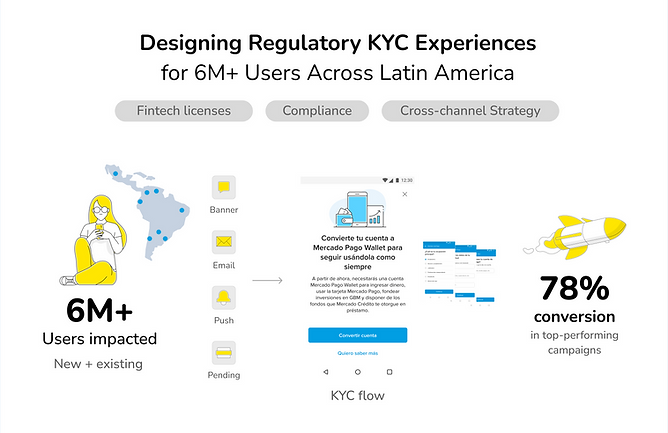
Overview
Description
As Mercado Libre expanded its fintech operations across Latin America, new regulatory requirements required the implementation of large-scale KYC (Know Your Customer) processes for millions of users.
These regulations required collecting sensitive personal and financial information from both new and existing users in order to comply with financial authorities in multiple countries, including new fintech licenses in Mexico and Colombia.
I designed the user experience for these regulatory data collection flows and the communication campaigns that encouraged users to complete them. The challenge was to transform a complex, legally driven process — often perceived as intrusive or confusing — into an experience that users could understand, trust, and complete.
Role
Product Designer
Collaboration
UX Writer, AML team, Legal, Product, Engineering
Scope
6 Countries across LATAM: Mexico, Colombia, Brazil, Chile, Uruguay, Ecuador
Timeline
3 years
The challenge
The regulatory process required collecting a large amount of sensitive information, often unfamiliar to users.
Typical flows required:
-
around 20 data points
-
financial documentation
-
legal declarations (e.g., Politically Exposed Person)
Several challenges emerged:
• Users had low motivation to complete the process
• Existing flows had outdated UX and fragmented logic
• Regulatory language was complex and difficult to understand
• Technical limitations restricted certain UX patterns (such as stepper navigation or gamification)
In high-regulation cases, failure to complete the flow could result in restricted platform access, making completion critical.
My role
I worked as part of design duos with UX Writers, focusing on both experience design and communication strategy.
My responsibilities included:
• Designing the end-to-end KYC flow
• Creating the interface for each step of the process
• Collaborating with AML and legal teams to challenge or refine data requirements
• Identifying opportunities to reduce friction in data collection
• Designing user communication campaigns to increase completion rates
This involved frequent collaboration with:
-
AML (Anti-Money Laundering)
-
Legal
-
Product
-
Engineering
Design Strategy
Instead of treating KYC as a purely regulatory requirement, we approached it as a trust-building experience. Three strategic pillars guided the design.
1. Reduce Data Friction
Regulatory teams often requested extensive information. A key part of the work involved questioning and refining these requirements.
We explored ways to:
• reduce the number of requested fields
• retrieve information from existing data sources
• extract data from uploaded documents instead of asking users to manually enter it
This helped minimize unnecessary friction in the experience.
2. Translate Regulation into Human Language
Many regulatory concepts are difficult for users to understand.
Working closely with the UX Writer, we focused on:
• simplifying legal terminology
• explaining why data was required
• building trust when requesting sensitive information
For example, declarations such as Politically Exposed Person (PEP) required clear explanations to avoid confusion or fear.
3. Design a Multi-Channel Compliance Campaign
Completing the KYC process was not just a product problem — it was also a communication challenge. Many users needed reminders and context to complete the process.
We designed a communication strategy across multiple channels:
• Push notifications
• In-app modals
• Email campaigns
• Platform banners
Users were segmented into groups such as:
-
individual users
-
business accounts
Campaigns included calendar planning and message sequencing to guide users toward completion.
Solution
The final experiences combined:
A structured KYC flow
A clearer step-by-step process guiding users through:
-
identity information
-
regulatory declarations
-
document submission
Even within technical constraints, the design aimed to create a clear narrative across the flow, reducing confusion.
Trust-focused UI
Screens were designed to:
• explain why each piece of information was needed
• reassure users when uploading sensitive documents
• reduce cognitive overload
Impact
These flows and campaigns supported regulatory compliance across multiple markets including:
Mexico, Colombia, Brazil, Chile, Uruguay and Ecuador.
Some campaigns reached millions of users, helping increase the number of users who completed the regulatory requirements and enabling Mercado Pago to continue operating under new financial regulations.
The IFPE campaign reached millions of users across the platform and significantly increased regulatory compliance rates.
Examples from the IFPE campaign results:
-
Campaigns targeting 2.2M users achieved a 78% completion rate
-
Campaigns targeting 1M users achieved a 53% completion rate
-
Larger user segments of over 3M users reached conversion rates between 21–27%
These results demonstrated the effectiveness of combining clear UX flows with a multi-channel communication strategy to drive compliance in a high-friction regulatory process.
(Detailed metrics omitted due to confidentiality)
Communication ecosystem
The campaign system supported millions of users across several countries, coordinating multiple touchpoints to drive compliance.
This project reshaped my understanding of product design in regulated environments.
Design is not only about delight — it is also about reducing friction in necessary processes.
Key takeaways:
• Transparency builds trust when asking users for sensitive information
• UX Writing plays a crucial role in regulatory experiences
• Strong design arguments can influence regulatory decisions and reduce unnecessary data collection
• Collaboration with legal and AML teams is essential in fintech product design